Introduction
TRIX is a momentum indicator that displays the percent rate-of-change of a triple exponentially smoothed moving average of a security’s closing price. It was developed in the early 1980’s by Jack Hutson, an editor for Technical Analysis of Stocks and Commodities magazine. Oscillating around a zero line, TRIX is designed to filter out stock movements that are insignificant to the larger trend of the stock. The user selects a number of periods (such as 15) with which to create the moving average, and those cycles that are shorter than that period are filtered out.
The TRIX is a leading indicator and can be used to anticipate turning points in a trend through its divergence with the security price. Likewise, it is common to plot a moving average with a smaller period (such as 9) and use it as a “signal line” to anticipate where the TRIX is heading. TRIX line crossovers with its “signal line” can be used as buy/sell signals as well.
Calculation
To calculate TRIX, you must first pick a period with which to create an exponential moving average of the closing prices.
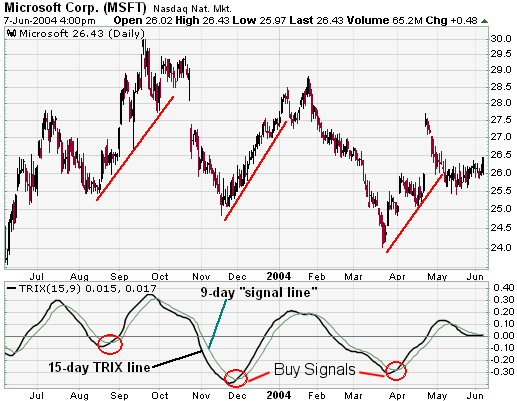
Since TRIX measures the rate-of-change of closing prices, a positive TRIX value is interpreted as a steady rise in the closing price of a security. A positive TRIX is thus akin to a positive trending price, allowing the indicator to act as a buy signal whenever it crosses up above the zero line. Similarly, crossing below the zero line suggests the price is tending to close down at the end of each period, which can be a sell signal.
The “signal line” mentioned earlier is also a useful buy/sell indicator. Since the signal line period is shorter, a cross above it suggests that recent stock prices are closing much higher. A buy signal is triggered when TRIX crosses above its signal line, and a sell signal is triggered when TRIX crosses below its signal line. This method can generate false signals during sideways price movements, so it works best when prices are trending. It is therefore wise to use TRIX in tandem with other indicators for confirmation.
In the Microsoft example, three bullish crossovers between the TRIX and its “signal line” were all followed by uptrends. These crossovers represented ideal buy points, for they quickly anticipated an increasing demand for the security.
very good site
One of the main problems with using moving average crossovers as actionable signals is that stocks may whipsaw back and forth across their average price