Please find the correct levels for nifty The Nifty Levels for 3rd February 2010 are First Resistance = 4902 First Support =4770 Second Resistance = 4987 Second Support =4723 Breakout above = 5034 Break down Below =4638 The above levels are for intraday only For Sure Shot pack and good Gains in Nifty Please visit Nifty Live Charts.com … [Read more...]
Chaikin Oscillator : Application and Chart
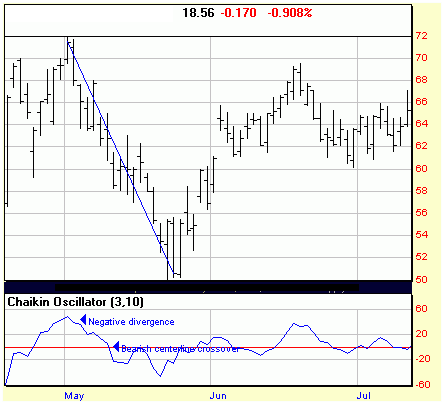
The Chaikin Oscillator, or Chaikin A/D Oscillator, stems from the concept behind the Accumulation/Distribution Line. The basic premise of the Chaikin Oscillator (and the A/D Line) is that the degree of buying or selling pressure can be calculated by the location of a close relative to the high and low for the corresponding period. There is a buying pressure when a stock closes … [Read more...]
Chaikin Oscillator : The Basic Concept
The Chaikin Oscillator was originally developed to compare volume and price levels for an asset. It was developed by Marc chaikin. The Chaikin Oscillator is usually used to indicate when an asset is overbought or oversold and thus, to indicate upcoming reversals. A trader first needs to generate an Accumulation/Distribution Line (A/D Line) for an asset in order to calculate … [Read more...]
Bollinger bands : Application and Chart

Bollinger Bands and Trading Without a doubt, Bollinger bands are one of the greatest tools ever created to aid an amateur trader with his entries and exits. The reaction of an upper or lower band, within the Bollinger bands, to approaching price provides the active trader with a vital sign of what will likely take place over the next few periods or more. This reaction … [Read more...]
Bollinger Bands : The Concept
Bollinger Bands, invented by John Bollinger in the 1980s are a technical analysis tool. Bollinger Bands, having evolved from the concept of trading bands, can be used to measure the highness or lowness of the price relative to previous trades. The main purpose of Bollinger Bands is to provide a relative definition of high and low. By definition, prices are high at the upper … [Read more...]