The Chaikin Volatility Indicator uses the percent change of two moving averages of a volume weighted accumulation-distribution line to determine the volatility of a financial data series. Chaikin quantifies volatility as a widening of the range between the high and the low price of a security. This does not take trading gaps into account as Average True Range does. As shown below, an increase in volatility can indicate a market bottom.
There are two ways to interpret this measure of volatility. One method assumes that market tops are generally accompanied by increased volatility (as investors get nervous and indecisive) and that the latter stages of a market bottom are generally accompanied by decreased volatility (as investors get bored).
Another method (Mr. Chaikin’s) assumes that an increase in the Volatility indicator over a relatively short time period indicates that a bottom is near (e.g., a panic sell-off) and that a decrease in volatility over a longer time period indicates an approaching top (e.g., a mature bull market).
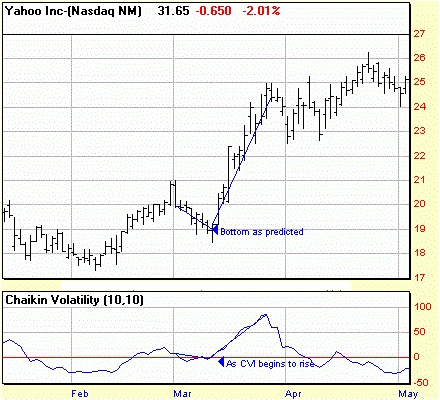
As with almost all experienced investors, Mr. Chaikin recommends that you do not rely on any one indicator. He suggests using a moving average penetration or trading band system to confirm this (or any) indicator.
Usage
Chaikin’s Volatility indicator measures the volatility of a security. High values indicate that prices are changing a large amount during the day. Low values indicate that prices are staying relatively constant. Note that both trending and level prices can have high or low volatility.
High volatility levels can sometimes be used to time trend reversals, such as market tops and bottoms. Low volatility levels can sometimes be used to time the beginning of new upward price trends following periods of consolidation.
Chaikin’s Volatility indicator is calculated by taking an exponential moving average of the difference between the high and low prices over the given period of time (MA Period). A percent change (or rate-of-change) is then taken for the moving average over the given period (ROC Period). The percent rate-of-change value is traditionally multiplied by 100 for easier graphing.
Since Chaikin’s Volatility uses exponential moving averages, it will have values at the beginning of the data series. However, you may want to ignore values prior to a sum of the two periods has completed.