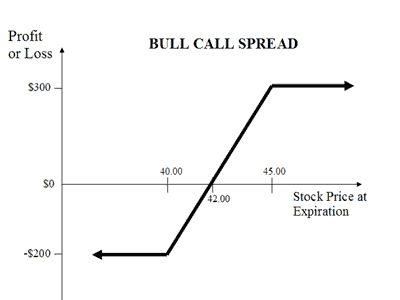
A type of options strategy used when a moderate rise in the price of the underlying asset is expected. It is achieved by purchasing call options at a specific strike price while also selling the same number of calls of the same asset and expiration date but at a higher strike. The maximum profit in this strategy is the difference between the strike prices of the long and short options, less the net cost of options. Most often, bull call spreads are vertical spreads.
A bull call spread is constructed by buying a call option with a low exercise price, and selling another call option with a higher exercise price.
Payoffs from a bull call spread
A bull spread can be constructed using two call options.
Often the call with the lower exercise price will be at-the-money while the call with the higher exercise price is out-of-the-money. Both calls must have the same underlying security and expiration month.
Limited Downside risk
The bull call spread strategy will result in a loss if the stock price declines at expiration. Maximum loss cannot be more than the initial debit taken to enter the spread position.
The formula for calculating maximum loss is given below:
- Max Loss = Net Premium Paid + Commissions Paid
- Max Loss Occurs When Price of Underlying <= Strike Price of Long Call
When to use
When you are mildly bullish on market price and/or volatility.
You can see from the above graph that a call bull spread can only be worth as much as the difference between the two strike prices. So, when putting on a bull spread remember that the wider the strikes the more you can make. But the downside to this is that you will end up paying more for the spread. So, the deeper in the money calls you buy relative to the call options that you sell means a greater maximum loss if the market sells off.
Like I mentioned, a call bull spread is a very cost effective way to take a position when you are bullish on market direction. The cost of the bought call option will be partially offset by the premium received by the sold call option. This does, however, limit your potential gain if the market does rally but also reduces the cost of entering into this position.
This type of strategy is suited to investors who want to go long on market direction and also have an upside target in mind. The sold call acts as a profit target for the position. So, if the trader sees a short term move in an underlying but doesn’t see the market going past $X, then a bull spread is ideal. With a bull spread he can easily go long without the added expenditure of an outright long stock and can even reduce the cost by selling the additional call option.